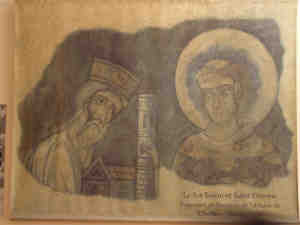
Boso of Provence King of Provence [6164] 24
- Born: Abt 840, Burgundy, France
- Marriage: Ermengarde [5737] in 876
- Died: 887, Vienne [France] about age 47
 Other names for Boso were Boso d’Autun and Boso d’Autun King of Provence. Other names for Boso were Boso d’Autun and Boso d’Autun King of Provence.

General Notes:
Acceded: 879
http://www.hull.ac.uk/php/cssbct/cgi-bin/gedlkup.php/n=royal?royal02588
http://en.wikipedia.org/wiki/Boso_of_Provence
Boso was a Frankish nobleman from the Bosonid -family, who was related to the Carolingian dynasty ,[1] who rose to become King of Provence (879 \endash 887).
Boso was the son of Bivin of Gorze , a count in Lotharingia . His aunt Theutberga was the wife of king Lothair II of Lotharingia . Boso was also a nephew of the Italian count Boso, for whom he was named, and of Hucbert, lay abbot of Saint Maurice d'Agaune, to which he succeeded as lay abbot in 869.
Service of Charles the Bald
In 870, Charles the Bald , King of West Francia , married Boso's sister Richilde . This marriage paved the way for Boso's career in the service of his royal brother-in-law. In the same year, Boso was appointed Count of Lyon and Vienne , replacing Gerard of Roussillon .
In 872, Charles appointed him chamberlain and magister ostiariorum (master of porters) to his heir Louis the Stammerer . Boso likewise received investiture as Count of Bourges . Louis was reigning as a subordinate king of Aquitaine , but because of his youth, it was Boso who looked after the administration of that realm.
In the autumn of 875, Boso accompanied Charles on his first Italian campaign and at the diet of Pavia in February 876 he was appointed arch-minister and missus dominicus for Italy and elevated to the rank of duke . He was probably also charged with the administration of Provence . He acted as a viceroy and increased his prestige even more by marrying Ermengard , the only daughter of the Emperor Louis II .
Out of favour
Boso disapproved of Charles' second Italian campaign in 877 and conspired with other like-minded nobles against his king. After Charles's death in October, these nobles forced Charles's son to confirm their rights and privileges.
Boso also formed close relations to the Papacy and accompanied Pope John VIII in September 878 to Troyes , where the Pope asked King Louis for his support in Italy. The Pope adopted Boso as his son and probably offered to crown Louis emperor. It is said that he wanted to crown Boso emperor.[2]
Independent rule
In April 879, Louis died, leaving behind two adult sons, Louis and Carloman . Boso joined with other western Frankish nobles and advocated making Louis III of France the sole heir of the western kingdom, but eventually both brothers were elected kings. Boso, however, renounced allegiance to both brothers and in July claimed independence by using the style Dei gratia id quod sum: by the Grace of God, that is what I am. He also claimed that his imperial father-in-law had named him as his heir. On 15 October 879 , the bishops and nobles of the region around the rivers Rhône and Saône assembled in the Synod of Mantaille elected Boso king as successor to Louis the Stammerer, the first non-Carolingian king in Western Europe in more than a century.[3]. This event marks the first occurrence of a "free election" among the Franks, without regard to royal descent, inspired by a canonical principle (but not constant practice) of ecclesiastical elections.
Boso's realm, usually called the Kingdom of Provence , comprised the ecclesiastical provinces of the archbishops of Arles , Aix , Vienne , Lyon (without Langres), and probably Besançon , as well as the dioceses of Tarentaise , Uzès , and Viviers .
After Louis and Carloman had divided their father's realm at Amiens in March 880, the two brothers joined to march against Boso. They took Mâcon and the northern parts of Boso's realm. Then uniting their forces with those of Charles the Fat , they unsuccessfully besieged Vienne from August to November.
In August 882, Boso was again besieged at Vienne by his relative, Richard , Count of Autun , who took the city in September. After this, Boso could not regain most of his realm and was restricted to the vicinity of Vienne.
He died in 887 and was succeeded by his son Louis the Blind .
Boso was the progenitor of three successful lineages, called the "Bosonids" by modern historians. Through his marriage to Ermengard of Italy he also had two daughters: Ermengard (c.877-917), who married Manasses, Count of Chalon, and Ethelberga, who married first Carloman and then William the Pious , Count of Auvergne .[4]
It is possible (though not certain) that the famous Guilla of Provence , queen of Upper Burgundy, was his daughter, then presumably by an earlier wife than Ermengarde.
Notes
^ His mother's father, Boso, provided a daughter, Tetburgis/Teutberga, Boso's aunt, to be wife of Lothair II <http://en.wikipedia.org/wiki/Lothair_II_of_Lotharingia>. (Constance B. Bouchard, "The Bosonids or Rising to Power in the Late Carolingian Age" French Historical Studies 15.3 (Spring 1988, pp. 407-431) genealogical table, p.409..
^ Caravale, Mario (ed). Dizionario Biografico degli Italiani: LXI Guglielmo Gonzaga \endash Jacobini. Rome <http://en.wikipedia.org/wiki/Rome> , 2003.
^ Constance B. Bouchard, "The Bosonids or Rising to Power in the Late Carolingian Age" French Historical Studies 15.3 (Spring 1988), pp. 407-431.
^ Riché, Les Carolingiens: Une famille qui fit l'Europe, genealogical table XII (Bosonides).
http://www.rpi.edu/~holmes/Hobbies/Genealogy/ps08/ps08_049.htm
French BOSON, king of lower Burgundy, or Provence, from 877.
The son of Buvin (or Beuves), Count of Ardennes, Boso was given the governance of Lombardy (876) by his brother-in-law Charles II the Bald, king of the West Franks (France), and received the title of duke. During the minorities of the West Frankish kings Louis III and Carloman, he convoked the bishops of Provence and had them proclaim him their king (Oct. 15, 879). Boso thereafter proceeded to expand his domains. The territory over which he usurped royal authority included not only Provence but many lands to the north, as far as Autun--an enlarged Burgundy.
In succeeding years, especially 880-882, Boso lost many of the marginal northern lands to the French and German Carolingians, who were reestablishing their authority. He was succeeded by his son, Louis, who in 901 became the Frankish emperor Louis III.
Noted events in his life were:
• Acceded, 879.
Boso married Ermengarde [5737] [MRIN: 1885], daughter of Louis II le Jeune Holy Roman Emperor and King of Italy [5738] and Engeberge [5739], in 876. (Ermengarde [5737] was born in 855 in Germany and died on 16 Dec 896 in Chiemsee.)
|